
- Centralize what customers don't see: operations, tech stack, and equipment.
- Specialize what customers do see: messaging, buying flows, and offers.
- Solve the customer's next problem without forcing every service into one brand.
- Build repeatable processes before hiring more headcount into broken workflows.
- Hide the organizational complexity so the customer only feels simplicity.
Running one business is challenging enough. Running multiple brands that share people, equipment, customers, technology, production space, and resources can become chaotic very quickly.
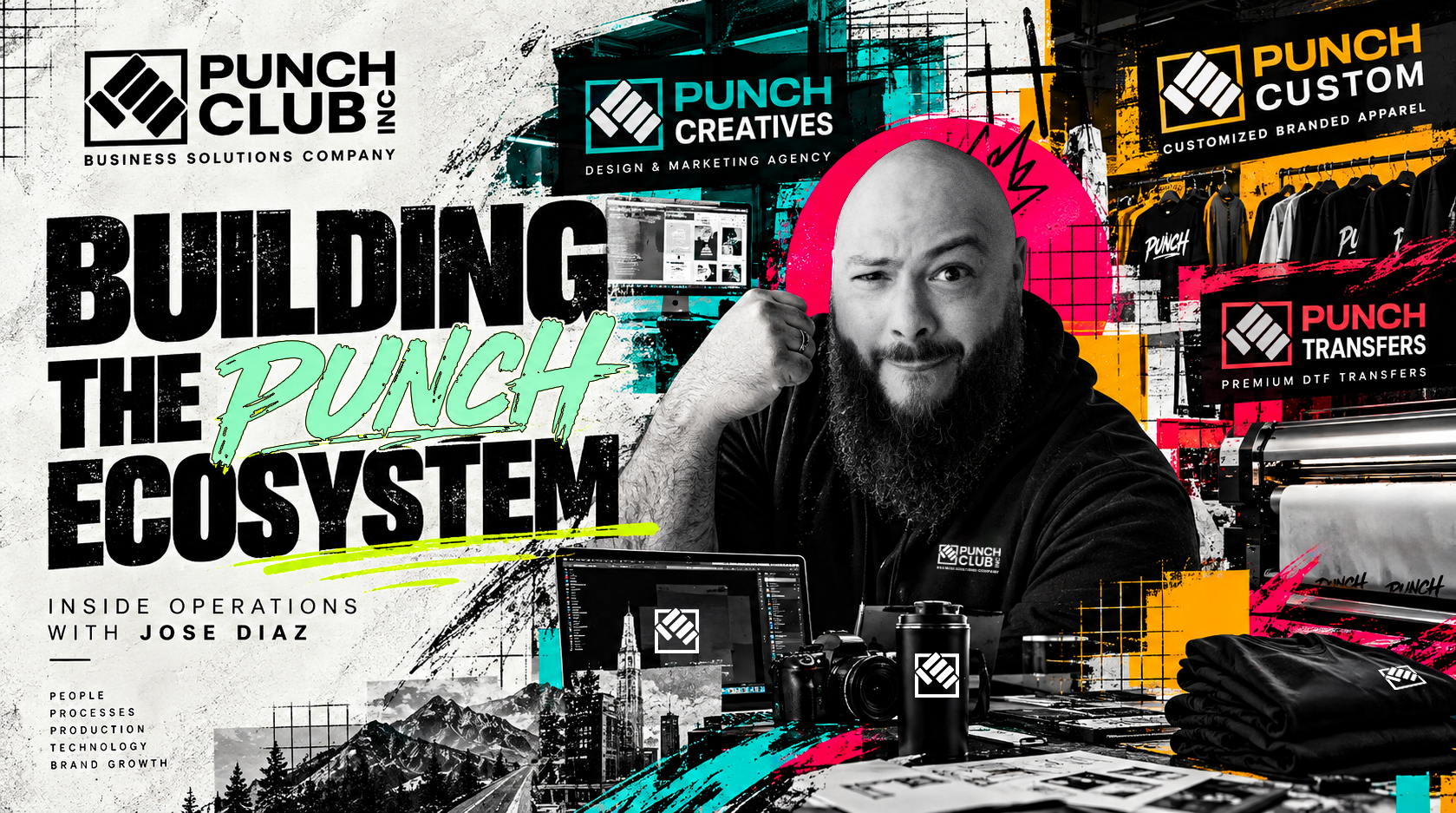
At Punch Club Inc., we've taken a different approach. Instead of trying to make one company be everything to everybody, we've built a connected group of specialized brands: Punch Creatives, Punch Transfers, and Punch Custom.
Each company serves a different purpose, but operationally, they work together. As Director of Operations, one of my biggest responsibilities is making sure those moving parts actually move in the same direction. That means looking beyond individual projects and asking a bigger question: How do we build systems that allow multiple brands to grow without multiplying the chaos behind them?
Why we didn't try to put everything under one brand
One of the biggest lessons I've learned in operations is that more services don't automatically create a stronger company. Sometimes they just create confusion.
A creative agency client looking for a website has a very different immediate need than a print shop looking for DTF transfers. A local police department that needs an online apparel store has different priorities than a business hiring us for a marketing campaign. We have the capability to help all of them, but that doesn't mean we should communicate with all of them the same way.
Instead of asking 'How many services can Punch offer?' we started asking 'What is the best business model for delivering each service?' That shift in mindset shaped the Punch Club Inc. ecosystem.
The Punch Club Inc. ecosystem
Think of Punch Club Inc. as the umbrella. Under that umbrella are three specialized divisions designed to solve distinct problems for our clients across Massachusetts and Rhode Island:
- Punch Creatives — The creative and marketing arm: brand identity, custom web design, digital marketing, SEO/SEM, video production, photography, and AI-powered automation.
- Punch Transfers — Built specifically for DTF printing, gang sheets, and apparel decorators who demand high print quality, accurate color, and fast turnaround without the overhead of an agency.
- Punch Custom — Custom apparel, team gear, and dedicated online apparel stores for businesses, schools, first responders, and organizations who want zero inventory hassles.
One customer, multiple problems to solve
This is where the multi-brand model becomes uniquely powerful. Imagine a South Coast company comes to Punch Creatives because they need a new website. During discovery, we discover their branding is inconsistent — that's a branding opportunity. Their staff needs uniforms — that's an apparel opportunity. They want a streamlined internal order portal — that's a Punch Custom opportunity. They want paid ads post-launch — that's a digital marketing opportunity. And if they eventually produce merchandise in-house, Punch Transfers has them covered.
This isn't about pushing upsells. It's about recognizing that real businesses rarely have only one problem. The operational goal is making sure we have a natural, world-class place to solve the next one.
Inside the shared operational core
If each brand had to independently purchase software licenses, camera packages, production space, CRM platforms, and administrative support, our overhead would be massive. Instead, Punch Club Inc. builds an operational infrastructure that powers every division:
- Shared creative talent — A photographer can shoot an editorial case study for Punch Creatives on Tuesday and product lines for Punch Custom on Wednesday.
- Shared production equipment — Commercial DTF printers, embroidery machines, and heat presses support multiple client streams under one roof.
- Shared technology & CRM — Customer data, project pipelines, and marketing automation run on unified systems so no context is ever dropped.
- Shared leadership & standards — Quality control, financial reporting, and client satisfaction metrics are held to the same standard everywhere.
Managing the chaos: visibility is everything
Shared resources only work when strict operational systems govern them. Otherwise, every department head naturally assumes their project is priority number one.
To keep our Fall River production facility running smoothly, we track six non-negotiable questions on every active job: Who owns the project? What is the hard deadline? What stage is it currently in? What machine or specialist does it need next? Who is waiting on whom? And did the customer receive what we promised?
Build repeatable processes before adding headcount
One classic trap for growing companies is assuming every bottleneck requires another hire. But hiring someone into a broken, undocumented process just gives you another person doing the wrong thing. Before adding payroll, I always ask: Can we eliminate the step? Can we simplify it? Can software or automation handle it? Only after exhausting those answers does a hiring conversation begin.
The customer shouldn't see the complexity
Our organizational chart is our problem, never the customer's. A client coming to Punch Creatives for a new website shouldn't have to figure out how our design files talk to our production floor. They want a stunning result delivered on schedule. Keep the operational complexity behind the curtain, and give the customer an experience that feels effortless.
Looking to take an idea from brand concept to web design and finished apparel production under one roof? Punch Creatives and the Punch family of brands bring the entire creative factory to your business across Massachusetts and Rhode Island. Let's build together.